Redefining Offline Robot Programming with AI
Learn how you can use AI to automate robot programming with digital twins.
What is OLP?
OLP (Offline Robot Programming) is the process of creating and validating robot programs in digital twin software before deploying the program on a real industrial robot. OLP allows engineers to test motion paths, avoid collisions, optimize cycle times, and develop control logic without stopping production or risking real equipment.
OLP gives teams a safe virtual space to iterate on robot instructions, validate sequential logic, then deploy tested programs to the physical system with far less downtime and rework. OLP and digital twins are becoming increasingly popular in the industrial automation and manufacturing space. Many companies today get high value out of robot programming software by reducing costs and shortening commissioning times.
Recent Advancements in AI
AI tools are seeing increasingly more use in engineering projects. Software developers today use advanced AI tools like Cursor to move faster by generating code. Software companies that use AI tools are becoming more productive than companies that neglect the use of these tools.
However, up until now, we have not seen significant usage of AI in the manufacturing industry. This is because manufacturing operates in the real world, whereas AI operates in the digital world. So the natural question becomes, how can we take advantage of the recent advancements in AI and use these powerful tools to increase productivity in manufacturing and industrial automation?
Fusing AI with Digital Twins
Digital twins provide a bridge between those two worlds. They give AI a digital environment where it can implement and test control logic rapidly inside simulation. This is simply not feasible in the real world. In ProtoTwin, it is possible to simulate robots at more than 50x real-time, allowing AI agents to explore, iterate, and validate robot behavior at a speed that would be impractical in physical production environments.
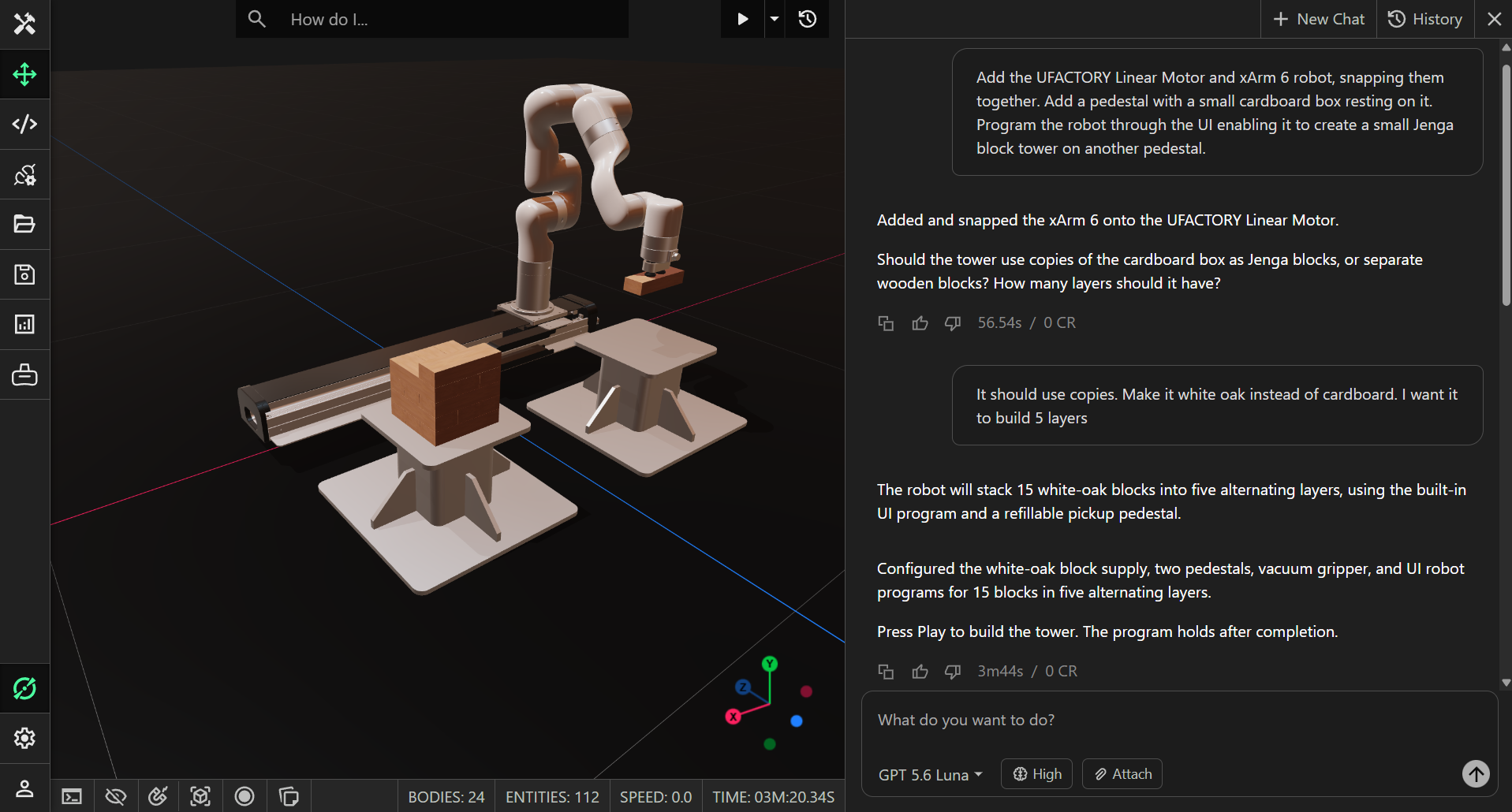
ProtoTwin provides a powerful and realistic physics-based simulation engine. This is a key advantage because digital twins are only useful when their behavior reflects the real world closely enough to support meaningful testing, optimization, and validation. Our AI agent Torq has access to tools which allow it to interact with the environment. Torq can read the current state of the world, create components for robots, configure these components, then iterate on the design and control logic without needing to manipulate atoms in the real world.
World Models and VLAs vs OLP
When people discuss AI and robotics, they are usually talking about general-purpose robots. AI robotics companies train foundation models for robots. Foundation models typically fall into two categories:
- VLA: Vision Language Action Models
- WAM: World Action Models
VLA models take in vision and text inputs and learn policies with RL that map these observations to robot joint actions. A VLA model is trained to predict what a robot should do next based on what it sees and what it knows about the task. The pre-trained vision language model is fine-tuned on robot demonstrations and datasets, primarily collected through imitation learning, to map vision and text inputs to motor commands.
World models on the other hand learn to predict future world states and robot actions by pre-training on videos. World models are fundamentally different to VLAs. This architecture is fundamentally more powerful than VLA architectures, since world models are trained to model the physical dynamics of the world, allowing an AI agent to simulate future trajectories before executing an action.
These models however are designed for general-purpose robots which operate in dynamic work environments. Applications include vacuuming, folding laundry, loading and unloading the dishwasher, tidying the house, etc. However, for industrial automation, offline robot programming can offer significant advantages over vision language action models and world models. OLP allows the robot arm to perform precise movements by solving the inverse kinematics and executing specialized instructions. These instructions can be added to the robot program, allowing the robot arm to perform a task repeatably, reliably and predictably. The execution of this program is deterministic, unlike VLAs or WAMs which predict an action probabilistically through forward propagation of a neural network.
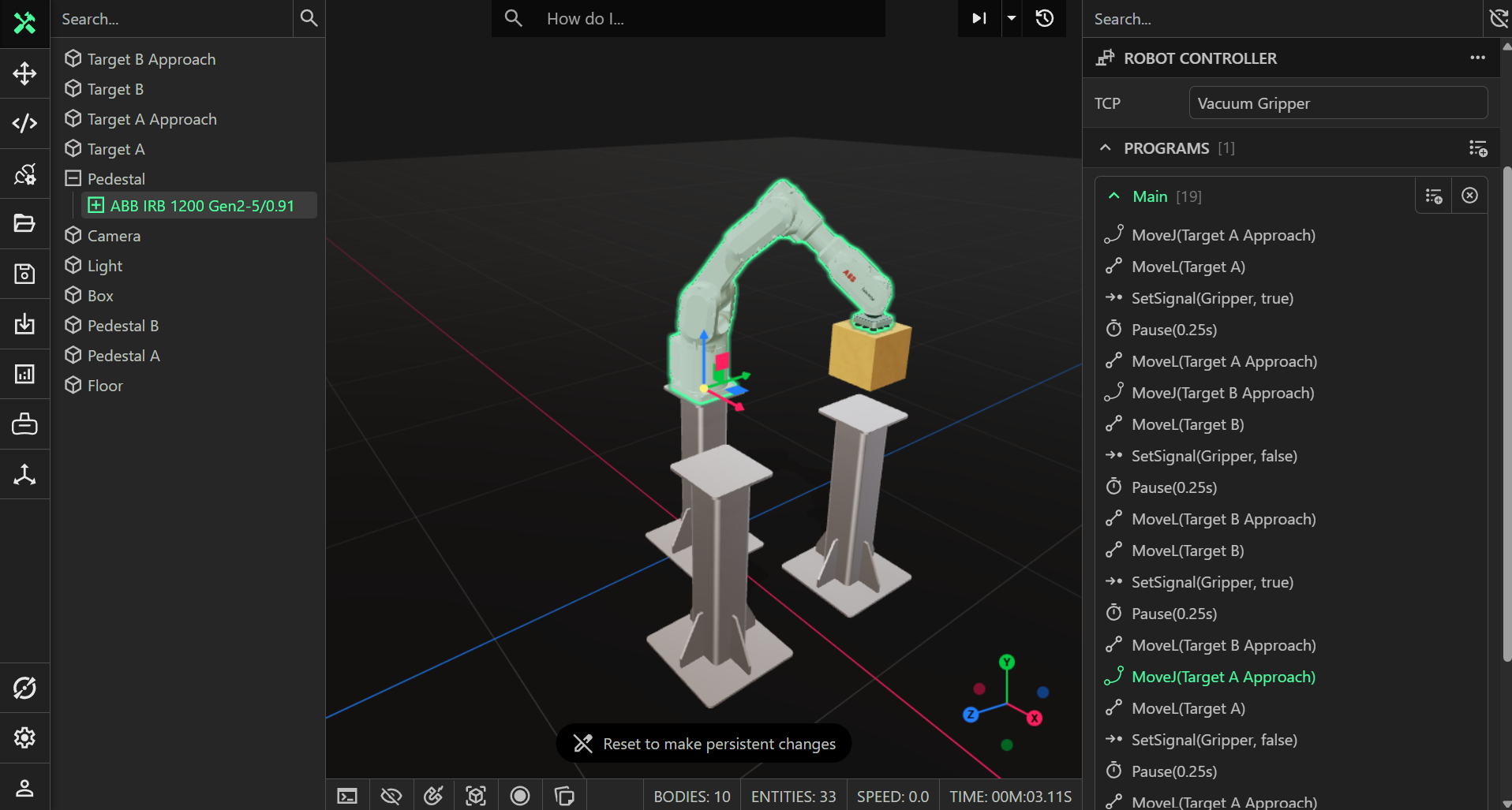
OLP offers more reliable task execution and lower cost compared to AI models that output motor commands. Moreover, it allows you to optimize cycle times with thorough testing in simulation. Applications include pick-and-place, arc welding, case erecting, palletizing, machine tending, etc.
Offline Robot Programming with AI
Robot programming with AI combines the reliability of traditional OLP with the speed and flexibility of modern AI tools. Instead of manually writing every robot instruction, you can now ask the AI agent to create the robot program for you. Robot programs in palletizing applications may include hundreds of moves, which are simple to program but ridiculously time consuming to create and test. What used to take days for humans can now be done in a few minutes with careful prompting of the AI agent inside ProtoTwin.
The AI can use the digital twin to refine the program and test it until the behavior is perfect, which is completely infeasible in the real world. Using AI with OLP now allows you to speed up commissioning times by many orders of magnitude compared to traditional robot programming software.
The advantage of ProtoTwin’s AI agent Torq is that it can execute standalone scripts. This allows Torq to position target entities for instructions on the robot controller, rotate targets, and read the position of other objects in the scene, such as pallets and conveyors. ProtoTwin is the only digital twin software in the world that gives its AI these capabilities.
Torq can not only create target entities, but it can add movement instructions to the integrated robot controller component programmatically. This allows the AI agent to organize the main robot program more effectively by calling other programs when executing a sub-task. It allows you as an engineer to better understand the program created by the AI. This makes testing, debugging and deployment more manageable. It allows you to be more confident in the control logic generated by the AI, which is important to know before running the program on a real robot.
ProtoTwin vs Traditional OLP Software
ProtoTwin is the only digital twin software in the world that allows you to train RL policies for robots and develop robot programs with AI. The key difference between VLAs and OLP is that VLAs output low-level robot joint actions, whereas the AI agent in ProtoTwin can also output high-level robot instructions. The solution depends on the task. ProtoTwin gives you the option to pick between either of these methods.
AI in ProtoTwin adds an additional layer of automation on top of the robot controller. AI can drastically speed up the development of offline robot programming, saving businesses tens of thousands of dollars. Compared to traditional OLP, ProtoTwin is significantly faster and more scalable.