Importing
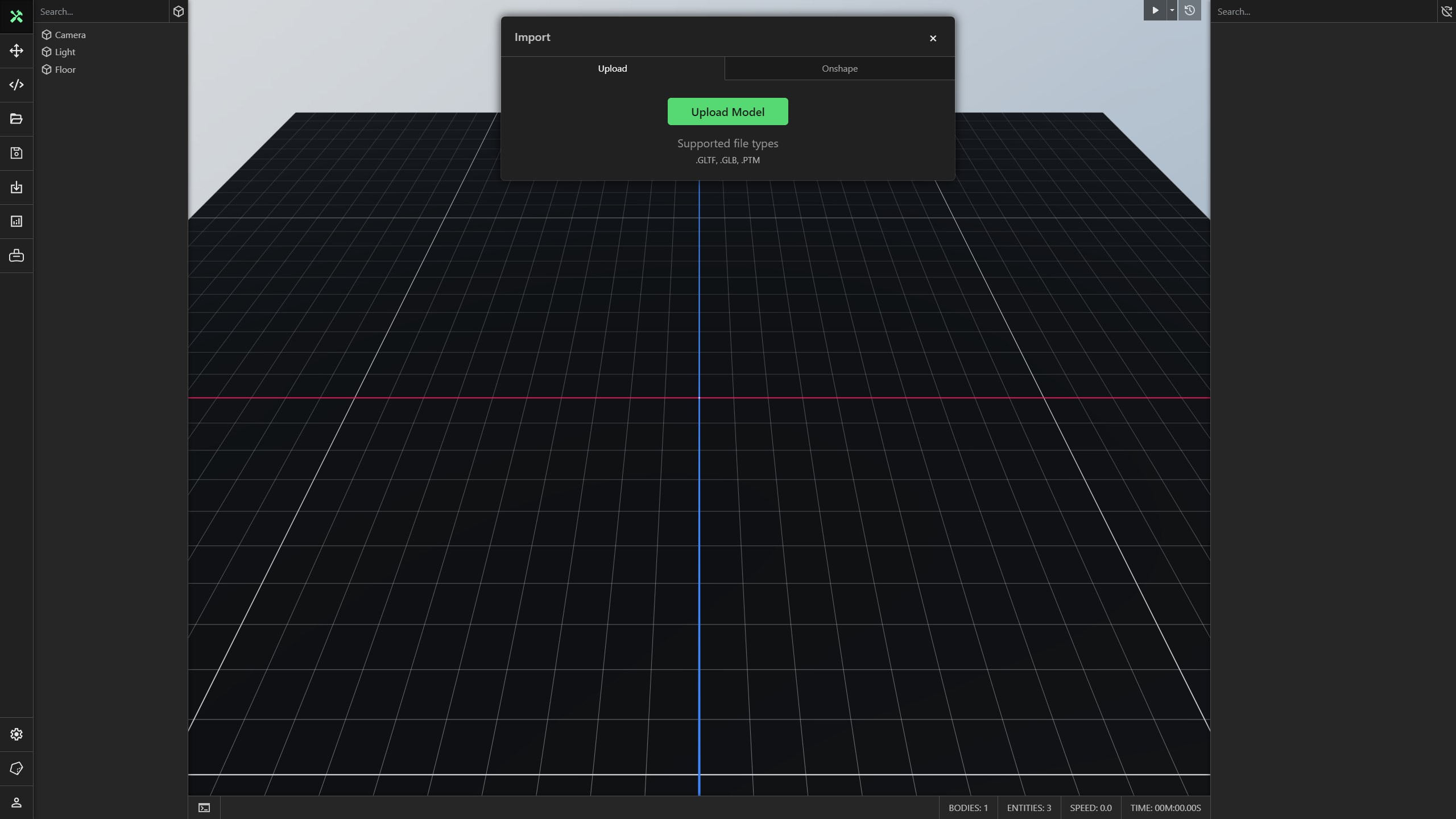
You can import CAD geometry and 3D assets into the software. You can import a CAD document directly from Onshape. You may also export the geometry from your CAD software to one of our supported formats and import the file into the software. You may also import other ProtoTwin models into an existing model.
Supported Files
ProtoTwin supports the following file types for importing 3D assets and CAD files into the digital twin software.
GLTF
The GLTF format has become the industry standard specification for the exchange/transmission of 3D geometry. ProtoTwin has native support for GLTF 2.0. We recommend using the GLB-variant, which encapsulates all the data into a single file using a more efficient binary format. Note that ProtoTwin does not currently support GLTF animations, mesh morphing or Draco compression.
STEP
STEP or STP is a standard CAD exchange format for transferring solid and surface geometry between different CAD applications. It is useful for importing parts and assemblies exported from mechanical design software.
DAE
DAE files use the COLLADA format, an XML-based format for exchanging 3D assets between applications. It can describe mesh geometry, materials and object hierarchy in a scene.
URDF
The Unified Robot Description Format describes a robot as a collection of links and joints, along with its visual geometry, collision geometry and inertia properties. If the robot references external meshes or textures, include the URDF file and its dependencies in a ZIP archive, preserving their relative paths.
USDZ
USDZ packages a Universal Scene Description model and its associated resources, such as textures, into a single .usdz file. This makes it convenient to exchange 3D assets without managing separate resource files. You must export the model as a USDZ package before importing it into ProtoTwin.
FBX
FBX is a 3D asset exchange format developed by Autodesk and supported by many 3D modeling software. It can store geometry, materials and scene structure in a .fbx file.
STL
STL represents the surface of a model as a mesh of triangles. The .stl file format is commonly used for 3D printing. The standard format stores geometry without materials or textures. You should check the scale of the model after importing, since STL does not specify units.
OBJ
OBJ is a widely supported format for exchanging 3D geometry, including polygon meshes. It can store texture coordinates and normals, while material definitions are usually stored in a separate .mtl file. If you have a .mtl file, it must be included in a ZIP archive with the .obj file.
PTM
PTM is ProtoTwin’s native file format. You can open a PTM model or import a .ptm file into your existing ProtoTwin model. Note that the light, floor and camera are excluded by default when importing into an existing model. Please also note that importing a .ptm file into an existing model can fail if scripts contain conflicts, so it’s important to give your exported types unique names before importing them into an existing model.
Unsupported Files
ProtoTwin does not currently support importing 3MF, SLDPRT/SLDASM, IGES/IGS, etc. You have a few options when managing CAD files with these extensions:
- Export your CAD file to one of our supported formats, if supported by the CAD software you are using.
- Convert the file using an online tool. This approach is not recommended since it could result in missing features.
- Import the file into a software with a powerful CAD kernel such as Onshape, create a new document, position the parts, create an assembly to group parts, then export the geometry to one of our supported file formats such as GLTF or STEP.
Onshape
You can import CAD directly from Onshape. Switch to the Onshape tab, then select any part studio or assembly from any of your Onshape documents to import. The info button can be used to open your document in Onshape. You can search for a document by:
- The name of the document.
- Pasting a link to the document. This works with your own documents and any public Onshape documents.
CAD Sync
If you have already imported an element into your ProtoTwin model and made changes to the CAD in Onshape, you can click the Sync button to syncronize the changes. If you have added components to the CAD in ProtoTwin, CAD Sync attempts to restore your components when synchronizing changes from Onshape. Note that CAD Sync only works when importing directly from Onshape.
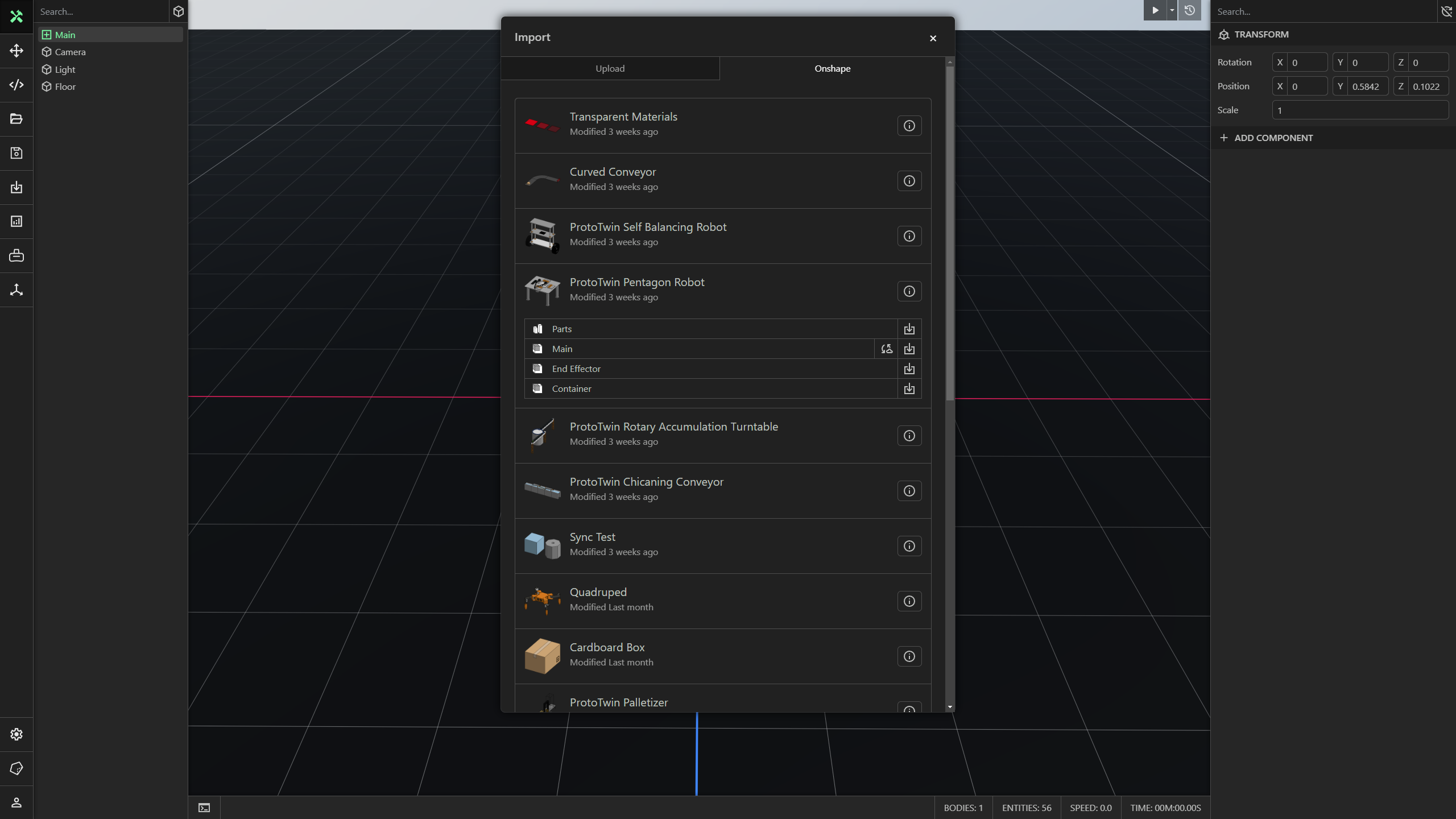
CAD Sync avoids needing to recreate your model in ProtoTwin after making changes to the CAD in Onshape. It is common that you will discover issues with your design, or opportunities to make improvements after simulation is performed. CAD Sync allows you to rapidly iterate on your design, without needing to recreate the model in ProtoTwin from scratch.
You may need to reselect some component properties after CAD Sync, but the changes you will need to make to your ProtoTwin model will be minimal, provided that the changes to your design are minimal as well. To use CAD Sync effectively, we strongly recommend adhering to the guidelines below. Your CAD should be the single source of truth. This means that you should only use ProtoTwin to add behavior (components) to parts of your CAD (entities).
- Do not create or delete any entities inside ProtoTwin.
- Do not reparent or group any entities inside ProtoTwin.
- Do not move, rotate or scale entities inside ProtoTwin.
If you decide to do any of the above, it is likely that after performing CAD sync those modifications inside ProtoTwin will be lost and therefore your model may no longer work.
Useful Tips
Here are some useful tips when importing CAD models that you should know about before creating a simulation of your robot or machine.
- When working with a robot that has many components, make sure each moving link is modeled as a separate part, or as a subassembly when a link is made up of many components. This structure allows the joints to be properly constrained.
- If your robot uses a custom end effector, such as a gripper mounted to link 6 of a 6-axis robot, configure the gripper as a subassembly and set it as a child of the link 6 subassembly. This structure avoids having to create a fixed joint between the gripper and link 6 of the robot.
- If your robot includes a spherical joint that cannot be easily selected using feature selection in ProtoTwin, add a small circular cutout in the CAD model so the anchor point can be easily selected.
- If your robot includes parts that are not positioned correctly, make sure to position the parts in your CAD software before importing them into ProtoTwin. This is very important, since positioning a part relative to another part in ProtoTwin can be very difficult.
- Group parts of your machine that move together into subassemblies. Add a physics component with a joint to the subassembly entity. If the parent entity has physics, since the grouped parts are local to the subassembly, they will will move relative to the parent even if they lack physics components themselves.
- When possible, simplify your CAD by removing detail such as nuts and bolts, in order to improve rendering and simulation performance before importing the CAD model into the application.